
Gaza Conversation - Part 3
This is not just a story but a testament to life under siege. A testimony of Shahd, who endured a bitter experience in Gaza, where war, destruction and displacement are inseparable from her daily life

These are a series of conversations I have had with people in Gaza, forming part of the book I am writing. Part 3 is inspired by a conversation with Shahd Nedal, a 17-year-old currently displaced in the Jabaliya Refugee Camp located in the North Gaza governorate. Shahd lives with her mother, her 18-year-old sister, and her two younger brothers, aged 11 and 9 months.
The IDF has intensified its siege on the three main governorates of North Gaza: Jabaliya, Beith Lahiya and Beit Hanoun. Isolating these three specifically, obstructing aid from entering and destroying all elements of life remaining inside. No potable water, no fresh food, and no medicine is allowed to enter. All roads and building structures have been flattened. The evacuation orders issued on the 6th of Oct. meant that 100,000 people fled to Gaza City, leaving behind approximately 70,000 - 60,000 people trapped inside, some refusing to leave - ‘We cannot leave, there are no longer any safe places to go to, they shoot at people trying to leave my mother decided we will stay where we are. We might as well die in our homes and with the people we love’ - Sahad told me once when I asked why you didn’t leave for the South like everyone else.
The North Gaza governorates will be remembered in history as the site of an ethnic cleansing campaign launched by the IDF in October 2024, aimed at flattening the area and facilitating resettlement.
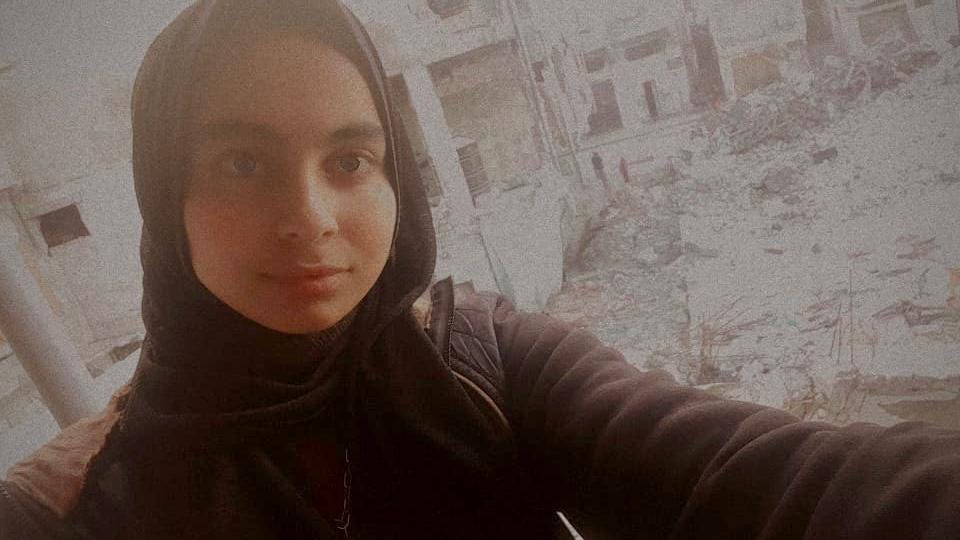
She was very keen to get in touch with the outside world, and her contact came through another friend of mine in the West Bank. Our conversations began on December 21 when I asked her to tell me her story in writing. She said her writing wasn’t very good, as she was only in 10th grade before the war started. She would try to write me a poem retelling her story.
She started by saying: ‘This is not just a story but a testament to life under siege. A testimony of Shahd, who endured a bitter experience in Gaza, where war, destruction, and displacement became inseparable parts of her daily life, later that evening, she sent me this:
The Poem of Life Under Siege - 21 Dec.
Chapter One: The Start of the War
on the 7th of Oct. 2023, the war began suddenly, as wars often do. We thought it would be brief, like previous ones—just a few days, and life would return to normal. That morning, we woke up and prepared breakfast as usual, with nothing hinting that this day would be any different. My father, the strong man who was our pillar of support, went out as normal, heading to the market to secure the household needs. Little did we know that it would be the last time we saw him.
Chapter Two: The Search and the Wait
Hours passed, and our anxiety grew. We tried to contact my father but to no avail. We searched for him everywhere: in hospitals, shelters, even in morgues. My father was known for his kindness and respected by everyone—how could he disappear like this all of a sudden?
Chapter Three: The First Shock
Finally, we received some news—a mixture of hope and dread. He had been found in the hospital, injured. Our hearts felt some relief, but this hope quickly faded. Doctors’ reports were conflicting—some mentioned minor injuries, while others spoke of severe ones.
Chapter Four: Deception and Ambiguity
Days passed, and the conflicting information only deepened our suffering. Every day brought a new version of his condition: an injury to the leg, then to the back, then to the arm. No one was telling us the full truth.
Chapter Five: The Tragedy
On the third day of the war, we received the news that shattered our world. My father had been martyred. We couldn’t believe it—the man who was always strong, who laughed and played with us, was gone.
Chapter Six: Destruction and Displacement
The war showed no mercy. After my father’s martyrdom, a series of tragedies followed: the bombing of mosques, the martyrdom of my aunt, the destruction of our home, repeated displacement, cuts to water and electricity, hunger, and poverty.
Chapter Seven: Life Under Siege
The siege imposed itself on our lives. Fear and anticipation became constant companions. No electricity, no water, no safety. Every day, we heard the sounds of bombing and destruction and saw tanks and bulldozers moving through the streets.
Chapter Eight: Displacement and Return
Displacement became a daily routine. We would leave our homes in fear of the bombings, only to return after hours or days, starting over again. This repeated cycle of fear and displacement drained us physically and emotionally.
Chapter Nine: Life After the War
The war ended, but life never returned to how it once was. We lost our homes, loved ones, and hope. We now live in the shadow of constant fear and anxiety.
Conclusion:
This is not just a story but a testament to the life of an entire people living under the weight of siege and destruction. It is a testament to resilience, endurance, and an unyielding hope that persists despite all odds.
I asked her how she and her family were surviving the siege, and she said: ‘We wake up every day and move forward. I help my mum take care of us every day - it’s a difficult job’ I asked her what life looked like and if she ever got lonely in the war. She replied:
I sit alone in my room, looking out the window at the destruction that has befallen my city. I felt as if the world had turned upside down. I could hear the sound of bombing in the distance, and I imagined seeing my grandfather smiling at me from the sky. I remembered his last words: "Don't be afraid, my dear, God is with us." Those words were like a small candle lighting my darkness, giving me hope for the future.
She mentioned that this war has taken away everything from her in the past year: her education, her friends, her life and her peace of mind. Surprised at what she meant by peace of mind, I asked her to elaborate; she said do you know what a Zananah is? , Tell me I replied, it’s a drone that is used to take pictures and monitor our every move. I sometimes see it in front of our window, it’s horrible! The feeling of being constantly monitored. I asked her to tell me more, and she wrote this:
The Zananah - 22 Dec.
I woke up to the sound of a sharp buzzing piercing the walls of our house. My heart pounded in my chest as if I could hear the ticking of the clock, preparing for a meeting with fate. I looked out the window and saw that grey plane flying in the sky, like a predatory bird staring at its prey. It was the drone, that vigilant eye that never misses a movement, monitoring and watching us from above. I looked at the children in the streets and felt them hiding from its sound, trembling in fear. It is a ghost flying in the sky of Gaza, and the silence of the graves is kinder than its sound.
It is not just the annoying sound of the drone, but it also affects our psychological and mental levels, causing fear, anxiety, and constant stress, especially for us in the blockade of Jabaliya. It signals that a military operation or targeting is coming for us. When we try to sleep, its presence leads to disturbances, negatively impacting our health and leading to constant depression. There are also individuals injured from the attacks, and its sound poses a danger to them, leading to increased blood pressure and heart problems for those with chronic illnesses. Hearing its sound, we, as the besieged, hesitate to leave the house or go elsewhere.
In Gaza, we are constantly under threat, and the sound of the drone is part of this harsh reality. Despite this, the Palestinian people try to live as normal a life as possible.
In a parallel reality, over festive some festive drinks, I was sharing with a friend, “Can you even imagine what that’s like? Constantly hearing that noise, knowing they’re watching your every move? It would drive anyone insane. Its sole purpose seems to be exposing Palestinians to relentless psychological trauma. “The IDF doesn’t just aim to kill Palestinians; it appears they want to sadistically torment them first, before taking their lives.”
One evening, I asked her how her day had been. She told me about the news of aid arriving in North Gaza and how she had accompanied her mum to queue for a box, but they left empty-handed. They then went to the nearby market to check if any food had arrived, only to find the contents of aid packages being sold at double or even triple the price. "Everything is upside down here! We have lost everything!" she exclaimed, clearly upset. I could sense the frustration and helplessness she was feeling. I encouraged her to write down her thoughts and emotions, and she promised to do so later.
The very next day, she shared her thoughts with me. Surprisingly, they weren’t about the lack of food or her anger at the situation but about something far more precious to a child—her beloved toy. Her words were a poignant reminder that, though she is 17 years old, she is still very much a child, mourning the loss of her cherished toy and, more profoundly, her lost childhood.
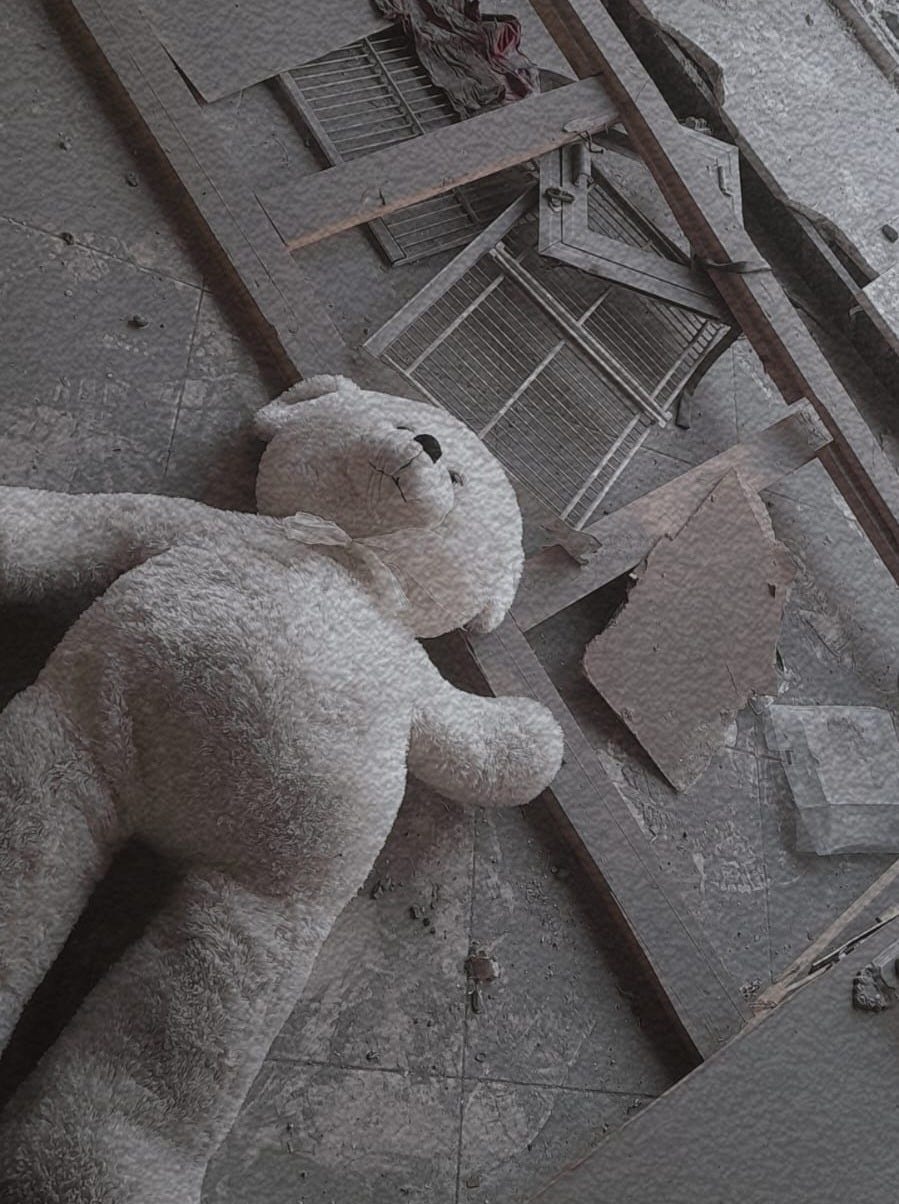
Goodbye, My Doll - 24 Dec.
I once had a soft white teddy doll that I loved more than anything. It was always by my side, especially when I slept, and I would share with it all my thoughts and secrets. To me, it was more than just a toy; it was my closest friend and confidant.
One day, loud explosions shook our house. My family and I hid in a safe place, but when I returned to my room after the attack, I searched everywhere for my doll. I finally found it buried under the rubble, dusty and damaged. A deep sadness washed over me as though I had lost a part of myself. I stood frozen, unable to breathe, staring at what was left of my beloved doll.
My heart pounded in my chest like the beat of a war drum. I tried to repair my home and fix my doll, but nothing worked. Tears streamed down my face like burning embers, and I was overcome with a hollow emptiness. Sitting on the ground, legs folded beneath me, I started to recall every moment I’d shared with my doll—how I used to play with it, how it silently listened to my dreams and secrets without ever speaking a word. I left it there in the rubble, as it was now dead like everything else.
I felt a profound loneliness, as though I had lost my dearest friend. Clenching my fists tightly and closing my eyes, I was filled with anger toward those who had taken my doll away. Why did this happen? What did I do to deserve this? I felt utterly helpless, unable to do anything to change what had been taken from me.
As the days went by, I slowly adjusted to the loss. Though I never forgot my doll, I came to understand that life must go on.
In the days that followed, The siege intensified on Kamal Adwan’s hospital, one of the last remaining in North Gaza governorates, the hospital and its staff, as well as the injured patients inside, came under direct attack from the IDF. On the 28th of Dec., reports came through social media platforms, showing medical staff stripped and forcibly marching out of the hospital minutes before it was completely burnt down. Its director, Dr. Hussam Abu Safiya, who broadcasted a cry for help on the 24th of Dec., was arrested and detained. His whereabouts are unknown.
According to Al Jazeera, the World Health Organization (WHO) condemned Israel’s “systematic dismantling” of Gaza’s health system and deemed it a “death sentence for tens of thousands of Palestinians”. The UN’s agency for Palestinian refugees (UNRWA) called for the “immediate flow” of humanitarian aid as babies freeze to death in Gaza.
According to the Guardian: “In a voice message shared by Abu Safiya, a member of the medical staff said: “We currently don’t know what will happen to us, the patients are being forcibly evacuated to the Indonesian hospital. They cut the oxygen from them; there are patients who [could] die at any moment.”
Rumours of a renewed ceasefire before Christmas have died down, and the people inside Gaza are still facing the worst. And as we close 2024, hopes for a ceasefire dissipate in the wind. Meanwhile, in a parallel universe, we indulge in canapés and sip mulled wine during the festive season, scarcely pausing to offer even a small prayer for those being exterminated with impunity on the other side of the world.
And that, my friend, is the grim reality of our existence today.